
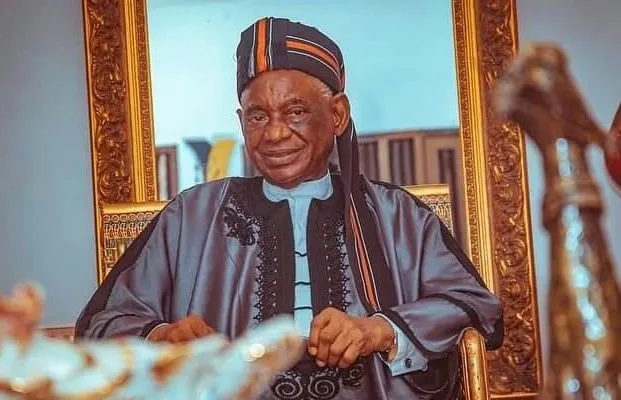
His Royal Majesty, Dr. Alhaji Ado Abdulrahman Ibrahim, CON, was the paramount traditional ruler of Ebiraland and the third person to occupy the modern Ohinoyi throne. He was widely known as the Ohinoyi of Ebiraland and was one of the prominent traditional rulers in Kogi State and Nigeria during his lifetime.
Born on 7 February 1929, he was a son of His Royal Highness Alhaji Ibrahim Onoruoiza Attah, the second traditional ruler of Ebiraland, and Hajiya Hauwawu Ozianuva. He belonged to the Omadivi Clan of Ebiraland and was born into a royal family with a long history of traditional leadership.
Prince Ado Ibrahim received both Western and Islamic education during his early childhood. He completed his Quranic and nursery education before proceeding to the Native Authority Primary School in Okene, where he completed his elementary education in 1940. He subsequently attended Okene Middle School, Ondo Boys High School and Oduduwa College, Ile-Ife, completing his secondary education in 1949.
His academic journey took him beyond Nigeria. In 1954, he obtained a Bachelor of Science degree from the London School of Economics. He later attended Harvard Business School in the United States, where he obtained a Master of Business Administration (MBA) in 1959. His international education and professional exposure distinguished him as one of the highly educated traditional rulers of his generation.
Before ascending the traditional throne, Ado Ibrahim established a career in business, management and industrial administration. In 1950, he joined the United African Company (UAC) as a special entrant under its accelerated management programme. By 1952, he had progressed through the company's accounting and sales departments and was appointed Manager of Kingsway Stores in Kaduna.
In 1953, he moved to Jos to work with Amalgamated Tin Mines of Nigeria Limited, where he served as Personnel Manager. He also received technical training in mining and prospecting, including further training organised by the Anglo-American Mining Corporation in Johannesburg, South Africa. His professional responsibilities included mining operations and the exploration of mineral resources.
His business career later developed significantly, and he became associated with major corporate and commercial activities in Nigeria. He was particularly recognised for his association with Nestlé Nigeria Plc, where he served as Chairman of the Board.
Ascension to the Throne of Ebiraland
Following the death of Ohinoyi Muhammed Sanni Omolori in 1997, Ado Ibrahim emerged as his successor and was installed as the Ohinoyi of Ebiraland on 2 June 1997 by the then Governor of Kogi State, Prince Abubakar Audu.
His ascension marked the beginning of a reign that lasted more than 26 years, making him one of the longest-serving traditional rulers in the modern history of Ebiraland.
As the paramount ruler, he presided over traditional institutions, cultural affairs and community leadership in Ebiraland. His palace became an important centre for traditional engagements, consultations, visitors and interactions with political leaders, business personalities and other prominent Nigerians.
One of the most recognisable symbols of his reign was the construction of the Azad Palace in Okene, which became associated with his royal household and traditional institution.
Throughout his reign, he remained an important figure in the traditional and cultural affairs of Ebiraland and participated in engagements involving the Kogi State Traditional Council and national leadership.
After 26 years on the throne, His Royal Majesty, Dr. Ado Abdulrahman Ibrahim, passed away on 29 October 2023 in Abuja at the age of 94. His death marked the end of an important era in the contemporary traditional history of Ebiraland. He was buried in Okene in accordance with Islamic rites.
Discussion 0
Join the Ebiraland community conversation! Sign in to leave a comment or reply.
No comments yet. Be the first to share your perspective!