
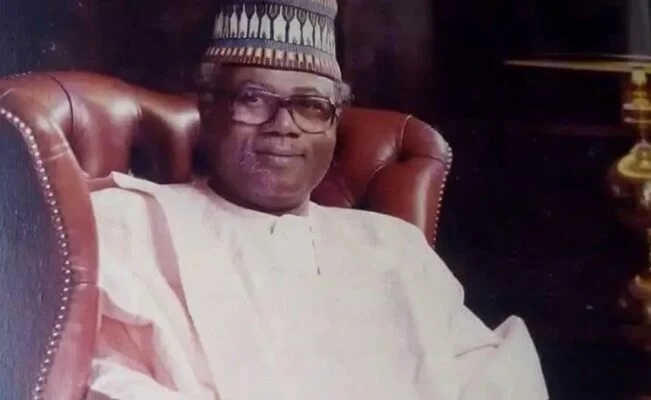
Alhaji Adamu Atta was born on October 18, 1927, in Okene, present-day Kogi State (then part of Kabba Province in the Northern Region), into the famous royal dynasty of His Royal Highness, Alhaji Ibrahim Onoruoiza Atta, the revered Atta of Ebiraland. Growing up in a prominent household that valued Western education alongside traditional leadership, he was exposed early on to public administration, diplomacy, and civic duty alongside his illustrious siblings, who included pioneering Nigerian technocrats and diplomats such as Abdul Aziz Atta,Judith Sefi Atta, and Mahmoud Atta.
He began his formal education at the Native Authority Elementary School in Okene in 1935 before proceeding to the Middle School in Okene and subsequently Achimota School in Accra, Ghana (then Gold Coast). Driven by a passion for jurisprudence, he traveled to the United Kingdom to study law at Lincoln's Inn, London, where he qualified as a Barrister-at-Law and was called to the English Bar in 1961. Upon returning to Nigeria, he joined the Northern Nigerian Civil Service and later served in the federal public service and corporate administration before transitioning into politics.
As Nigeria prepared for the return to democratic rule in the late 1970s, Atta was elected to the 1977–1978 Constituent Assembly, where he represented Okene/Okehi and contributed to drafting the 1979 Constitution of the Federal Republic of Nigeria. When the ban on partisan politics was lifted in 1978, he joined the National Party of Nigeria (NPN). Working closely with key political stakeholders across the state—most notably the influential Ilorin political leader Dr. Olusola Saraki—Atta secured the NPN gubernatorial ticket for old Kwara State (which then encompassed present-day Kwara State and the Western and Central parts of Kogi State).
In the July 1979 gubernatorial election, Atta defeated his main challenger, Chief Josiah Sunday Olawoyin of the Unity Party of Nigeria (UPN), and was sworn in on October 1, 1979, as the first democratically elected Civilian Governor of Kwara State. His four-year administration was characterized by ambitious industrialization, healthcare expansion, and infrastructural development across all zones of the state. In 1983, following a political rift within the state chapter of the NPN, he lost his re-election bid to Chief Cornelius Olatunji Adebayo of the UPN.
Following the collapse of the Second Republic in December 1983, Atta remained a respected elder statesman and returned to national constitution-making during the 1994–1995 National Constitutional Conference in Abuja. Alhaji Adamu Atta passed away after a protracted illness in Abuja on May 1, 2014, at the age of 86, and was laid to rest in his hometown of Okene.
💬 Community Discussion 0
Representing Ebira voices across all LGAs & the DiasporaSign in with your Email or Phone Number — or create your cultural profile with your Ebira Name, LGA, and Hometown — to comment and react.
No comments yet. Be the first voice from the community to share your thoughts!