
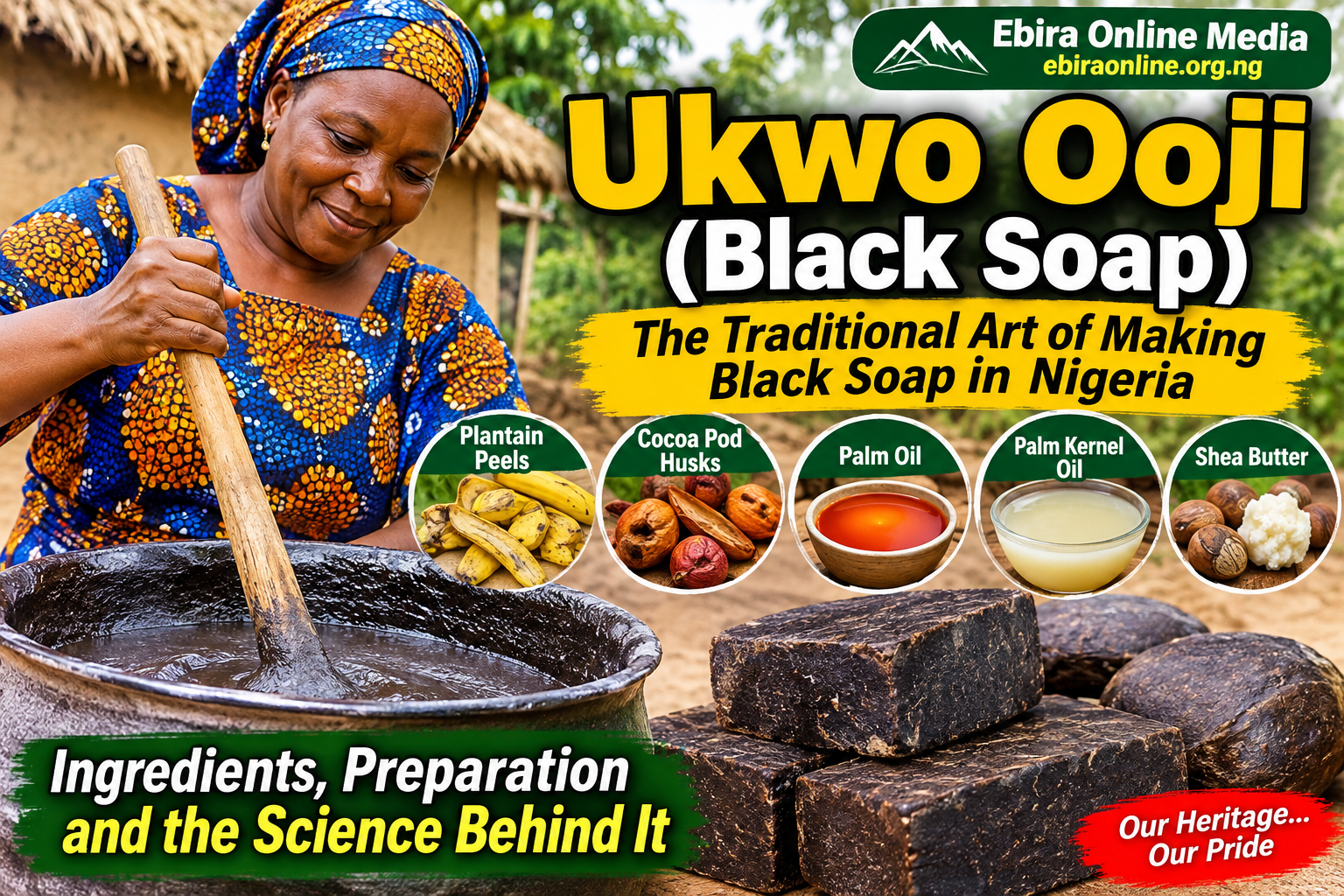
Long before the introduction of commercially manufactured bathing soaps, Nigerian communities had developed their own methods of producing soap from natural materials found in their environment. Among these traditional products is African Black Soap, a locally made soap whose production involves plant ashes, vegetable oils and a process of chemical transformation that has been practised across generations.
In the Ebira language, black soap is known as Ukwo Ooji. The word Ukwo means soap, while Ooji means black. The name reflects the characteristic dark appearance of this traditional cleansing product.
Although African Black Soap is widely associated with Yoruba communities in southwestern Nigeria, where it is popularly called Ose Dudu, the knowledge and use of traditional black soap extend beyond one ethnic group. Similar traditional soaps are known in other parts of Nigeria and West Africa, with differences in names, ingredients and preparation techniques.
What makes this traditional soap particularly interesting is that its production is not simply a matter of mixing oils and ashes. It involves a chemical process known as saponification, through which naturally occurring fats and oils are transformed into soap using an alkaline substance obtained from plant ashes.
This article explores how Nigerians traditionally make black soap, the materials used, the scientific reasons behind their selection, and the importance of preserving this indigenous knowledge.
Understanding the Origin and Tradition of Nigerian Black Soap
African Black Soap is a traditional West African cleansing product made primarily from vegetable oils and alkaline extracts obtained from the ashes of burnt plant materials.
In Nigeria, traditional soap makers have historically relied on agricultural by-products and materials that are readily available in their communities.
These include:
Plantain and banana peels.
Cocoa pod husks.
Palm fruit bunches and palm processing residues.
Firewood and other suitable plant materials.
Palm kernel oil.
Palm oil.
Shea butter.
Other locally available vegetable fats.
Instead of throwing away these agricultural materials, traditional producers discovered that their ashes could be processed into an alkaline liquid capable of reacting with vegetable oils to produce soap.
A scientific study by O. E. Taiwo and F. A. O. Osinowo, published in Bioresource Technology in 2001, investigated the suitability of agricultural wastes for traditional black soap production.
The researchers examined cocoa pod husks, palm-bunch waste, sorghum chaff and groundnut shells. Their findings confirmed that these materials contain useful alkaline compounds, particularly potassium carbonate, which can be extracted and used in soap production.
This research provides scientific evidence that traditional Nigerian soap making is based on a practical understanding of plant chemistry and the reuse of agricultural resources.
The Traditional Materials Used in Making Black Soap
There is no single recipe for African Black Soap. The ingredients depend on the community, the availability of raw materials and the preferences of individual soap makers.
However, the following materials are among the most widely documented ingredients in Nigerian traditional black soap production.
A. Plantain Peels

Plantain peels are one of the traditional sources of alkali used in black soap production.
The peels are collected, dried and burnt into ashes. The ashes are then mixed with water to extract alkaline compounds.
Scientific explanation:
Plantain peels contain potassium and other mineral elements. When properly burnt, some of these minerals remain in the resulting ash as inorganic compounds, including potassium carbonate.
Potassium carbonate is important because it contributes to the alkaline nature of the ash extract.
The alkaline liquid reacts with the fats and oils used in soap making, helping to transform them into soap.
A study published in the Journal of Applied Sciences and Environmental Management in 2002, titled Solid Soap Production Using Plantain Peel Ash as Source of Alkali, investigated the use of plantain peel ash in soap production.
The researchers demonstrated that plantain peel ash could provide an alkaline extract suitable for producing soap when combined with palm oil and palm kernel oil.
B. Cocoa Pod Husks
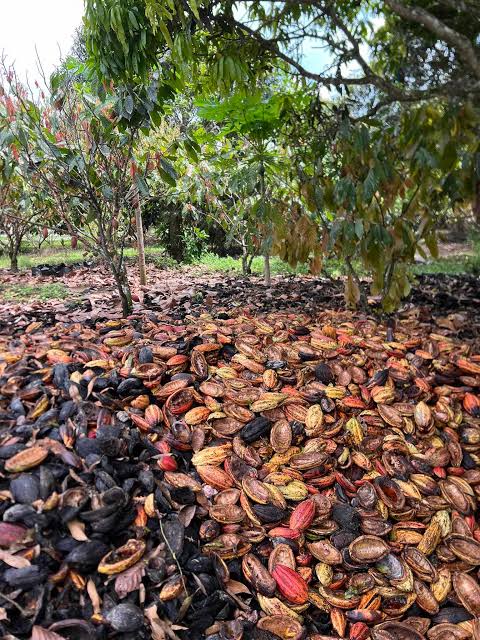
Cocoa pod husks are another important raw material in traditional Nigerian black soap production.
After cocoa beans are removed from their pods, the remaining husks are often discarded. However, these husks can be dried and burnt to produce ash for extracting alkaline compounds.
Scientific explanation:
Cocoa pod ash contains a significant amount of potassium carbonate.
In the 2001 study by Taiwo and Osinowo, cocoa pod ash contained approximately 56.73% potassium carbonate, making it the richest source among the four agricultural wastes investigated.
The researchers also found potassium carbonate in palm-bunch waste, groundnut shells and sorghum chaff ash.
This explains why cocoa pod husks are particularly useful in traditional soap making: their ash provides an important alkaline component needed for the saponification process.
C. Palm Fruit Bunches and Palm Processing Residues

Palm fruit bunches are another traditional source of ash.
After palm fruits are removed during processing, the remaining fibrous bunch material can be dried and burnt. The resulting ash can be used to prepare an alkaline solution.
Scientific explanation:
Research has identified potassium carbonate and other potassium and sodium compounds in palm-bunch ash.
Taiwo and Osinowo reported that their palm-bunch ash contained approximately 43.15% potassium carbonate.
This makes palm processing waste another valuable source of alkali for traditional soap production.
The use of this material also demonstrates how traditional soap makers can turn agricultural waste into useful household products.
D. Palm Kernel Oil (Udẹ)

Palm kernel oil is extracted from the kernels found inside palm fruits.
It is an important ingredient in traditional black soap and is particularly valued for its contribution to cleansing and lather formation.
Scientific explanation:
Palm kernel oil contains triglycerides made up of different fatty acids, including lauric acid and myristic acid.
When these fats react with an alkaline solution, they undergo saponification and form potassium or sodium salts of fatty acids.
These salts are the actual cleansing substances in soap.
The fatty acid composition of palm kernel oil contributes to the cleansing properties, foam production and physical characteristics of the finished soap.
E. Palm Oil

Palm oil is extracted from the fleshy outer portion of the oil palm fruit.
It is another commonly used ingredient in Nigerian traditional soap production.
Scientific explanation:
Palm oil contains triglycerides rich in fatty acids such as palmitic and oleic acids.
During saponification, these triglycerides react with the alkaline extract to produce soap.
The different fatty acids contribute to the finished soap's firmness, cleansing behaviour and texture.
Palm oil is also naturally reddish-orange because it contains carotenoid pigments. However, the final colour of traditional black soap depends on several factors, including the source of ash, processing conditions and other ingredients.
F. Shea Butter (Okume)

Shea butter is obtained from the nuts of the shea tree, which grows widely across parts of West Africa.
It is sometimes added to traditional black soap to influence its texture and fatty composition.
Scientific explanation:
Shea butter contains triglycerides rich in stearic and oleic acids.
These fatty acids contribute to the physical properties of the resulting soap.
Shea butter also contains unsaponifiable substances, including naturally occurring triterpenes and tocopherols, which are not completely converted into soap during saponification.
These components are of interest in cosmetic science because of their potential skin-conditioning and antioxidant properties.
However, the presence of shea butter does not automatically make every black soap gentle or suitable for all skin types.
G. Water
Water is essential in the traditional production process.
It is used to extract alkaline compounds from plant ashes and to facilitate the reaction between the alkaline liquid and the vegetable oils.
Scientific explanation:
Water acts as the medium through which soluble alkaline compounds are extracted from ash.
It also allows the alkaline substances and oils to interact during the soap-making process.
The amount of water used influences the concentration of the alkaline extract and can therefore affect the production process.
How Nigerians Traditionally Make Black Soap
Traditional black soap production involves several stages. Although the exact techniques vary among communities, the general process follows a similar pattern.
Stage One: Collection and Preparation of Raw Materials
The first step is to collect the agricultural materials that will provide the ash.
Depending on the local method, these may include plantain peels, cocoa pod husks, palm fruit bunches or other suitable plant residues.
The materials are sorted to remove stones, sand, dirt and unwanted substances.
They are then spread out under the sun and allowed to dry properly.
Drying is important because wet plant materials do not burn efficiently. Proper drying also makes it easier to produce ash suitable for preparing an alkaline extract.
Stage Two: Burning the Plant Materials into Ash
After drying, the plant materials are placed in a suitable fire-resistant area and burnt until they are converted into ash.
The ash is collected after it has cooled.
Traditional producers may use different plant materials separately or combine them, depending on their preferred method.
The quality of the ash is important because different plants produce different mineral compositions.
Scientific research has established that cocoa pod husks, palm-bunch waste, groundnut shells and sorghum chaff produce ashes with different concentrations of potassium carbonate.
This means that the choice of plant material can influence the properties of the final soap.
Stage Three: Extracting the Alkali from the Ash
This is one of the most important stages in traditional black soap production.
The collected ash is placed in a clean container, and water is gradually added.
The mixture is stirred and allowed to release its water-soluble mineral compounds.
The liquid is then separated from the solid ash by allowing the particles to settle and carefully filtering the mixture through a clean filtering material.
The resulting liquid is commonly referred to as ash extract or traditional potash solution.
It is this alkaline liquid, rather than the solid ash itself, that is used in the soap-making process.
What happens scientifically?
The water dissolves soluble alkaline substances present in the ash, particularly potassium carbonate and other mineral salts.
The resulting liquid has an alkaline pH.
Its suitability for soap making depends on its chemical composition and concentration, which can vary significantly according to the original plant material and extraction method.
Traditional producers often assess the extract using experience and established household techniques. However, scientific production requires proper measurement of alkalinity to ensure consistent results.
Stage Four: Preparing the Vegetable Oils
The next step involves preparing the oils and fats.
Palm kernel oil, palm oil and, where desired, shea butter are measured and placed in a suitable cooking pot.
The oils are gently heated to make them easier to mix.
Where more than one oil is used, they are combined to achieve the desired consistency and cleansing characteristics.
Stage Five: Combining the Ash Extract with the Oils
The prepared alkaline liquid is gradually introduced into the heated vegetable oils while the mixture is continuously stirred.
This is where the major chemical transformation begins.
The combination is heated and stirred until the mixture thickens and gradually develops the characteristic appearance and texture of traditional soap.
Depending on the concentration of the ash extract, the types of oils used and the heating conditions, this process can take different amounts of time.
Stage Six: Cooking and Continuous Stirring
The mixture is carefully cooked while being stirred to encourage the reaction between the alkaline substances and the oils.
As the process continues, the fats and oils are converted into soap.
The soap may develop a thick, soft or dough-like consistency, depending on the ingredients and the amount of water present.
The dark appearance associated with traditional black soap can also be influenced by the raw materials and processing conditions.
It is important to understand that blackness is not proof that saponification is complete. Properly processed soap must be assessed for its chemical quality and safety.
Stage Seven: Cooling, Moulding and Storage
When the soap has reached the desired consistency, it is removed from the heat and allowed to cool.
It can then be shaped into balls, blocks or other convenient forms.
Some producers allow the soap to dry or mature further before packaging, while others traditionally sell it in a soft, unwrapped form.
The finished soap should be kept in a clean, dry container and protected from contamination.
The Science Behind Black Soap: Understanding Saponification
One of the most interesting things about traditional black soap is that its production is based on an established chemical reaction.
This reaction is called saponification.
Vegetable oils and animal fats contain substances known as triglycerides. These are molecules formed from glycerol and three fatty acids.
When triglycerides react with an alkaline substance, their chemical bonds are broken, producing glycerol and salts of fatty acids.
These fatty acid salts are what we know as soap.
The general reaction can be represented as:
Triglyceride + Alkali → Soap + Glycerol
When potassium-based alkali is involved, potassium salts of fatty acids are formed. These generally produce softer and more soluble soaps than their sodium counterparts.
This helps explain why traditional ash-based black soaps can have a softer consistency than many commercially manufactured bathing bars.
The chemistry of soap also explains how it removes dirt.
Each soap molecule has two important parts:
A water-attracting head, which interacts with water.
An oil-attracting tail, which interacts with grease and oily dirt.
When soap is applied with water, its molecules help surround oily dirt and suspend it in water so that it can be washed away.
This is the fundamental cleansing mechanism behind both traditional and industrially manufactured soaps.
Why Does Black Soap Have Its Characteristic Dark Colour?
The dark colour is one of the most recognisable features of traditional African Black Soap.
However, it is scientifically incorrect to assume that all black soap gets its colour from one ingredient.
The final colour can be influenced by:
The type of plant materials burnt to produce the ash.
Residual mineral substances and trace compounds.
Naturally occurring pigments in the ingredients.
The amount of carbonaceous material remaining in the process.
The temperature and duration of cooking.
The degree of browning or charring during production.
A particularly interesting Nigerian study published in 2002 by Onyegbado, Iyagba and Offor investigated the production of solid soap using plantain peel ash.
The researchers examined factors responsible for the black colour of locally produced soap. Their findings showed that black particles and certain metallic ions in the ash extract could contribute to colour formation. They also found that excessive heating during saponification could cause charring.
In their experiment, when these factors were controlled, the researchers produced a soap that was almost white.
This demonstrates that the dark colour of traditional soap is influenced by the production method and raw materials rather than being a direct measure of its cleansing power.
What Scientific Research Says About the Benefits of African Black Soap
African Black Soap has been used traditionally for bathing, cleansing and personal hygiene for generations.
Modern scientific research has investigated some of its chemical and biological properties.
A 2021 review by Nigerian dermatologists Adebola Ogunbiyi and Nkechi A. Enechukwu, published in Dermatologic Therapy, examined the physicochemical properties, phytochemical composition and reported uses of African Black Soap.
The review discussed studies indicating antimicrobial activity against certain bacteria, including Staphylococcus and some Streptococcus species.
However, it also emphasised that several medicinal claims associated with black soap remain anecdotal and require further scientific investigation.
The following are some of the areas of interest.
A. Cleansing and Removal of Dirt
The primary established function of soap is cleansing.
The fatty acid salts produced during saponification act as surfactants, helping water remove grease, dirt and other substances from the skin.
This is a scientifically established property of soap and is not exclusive to African Black Soap.
B. Antimicrobial Properties
Some laboratory studies have reported that African Black Soap can inhibit the growth of certain microorganisms.
This is particularly interesting in tropical environments where bacterial skin infections can occur.
However, laboratory antimicrobial activity does not automatically mean that black soap can treat infections in human beings.
It should not be used as a replacement for prescribed antimicrobial medication.
C. Traditional Use for Acne and Oily Skin
Black soap is commonly used by people who want to remove excess oil and dirt from their skin.
Its cleansing properties may help remove oily residues from the skin surface.
Nevertheless, there is insufficient clinical evidence to establish that traditional black soap cures acne.
In addition, its alkaline nature may cause dryness or irritation in some individuals, especially those with sensitive skin.
D. Traditional Use for Skin Conditions
In several Nigerian communities, black soap has traditionally been used as part of personal hygiene practices for people experiencing various skin complaints.
Some formulations also incorporate herbs and other plant extracts.
Although research has identified potentially useful antimicrobial and phytochemical properties, there is not enough high-quality clinical evidence to recommend black soap as a treatment for eczema, fungal infections, wounds or other skin diseases.
Important Safety Considerations in Traditional Black Soap Production
Although traditional black soap is made from locally available materials, its natural origin does not automatically guarantee that every batch is safe for use.
The quality of the finished product depends on the purity of the raw materials, the concentration of the alkaline extract, the completeness of saponification and the hygiene of the production environment.
A. Excessive Alkalinity
The alkaline extract is essential for converting oils into soap. However, excessive alkali can leave unreacted alkaline substances in the finished product.
Such soap may cause skin irritation, dryness or even chemical burns if the concentration is sufficiently high.
This is why modern soap manufacturing requires proper testing of free caustic alkali and other quality parameters.
B. Contamination of Ash
Ash collected from materials burnt in unsuitable environments may contain unwanted contaminants.
For example, burning painted wood, treated timber, plastic-containing waste or materials exposed to industrial chemicals can introduce undesirable substances into the ash.
Only clean, identifiable plant materials should be used.
C. Heavy Metals
A 2021 study titled Comparative Chemical Analysis of Indigenous Nigerian Soaps with Conventional Ones, published in the journal Heliyon, investigated the chemical composition of locally produced soaps obtained from markets in Ile-Ife and Okitipupa.
The researchers detected heavy metals, including mercury, lead and cadmium, in the samples examined.
Their findings highlighted the importance of carefully selecting raw materials and monitoring the quality of indigenous soaps.
A separate 2024 study published in the West African Journal of Pharmacy also examined the quality, antimicrobial activity, heavy-metal content and safety of selected African black soaps.
The researchers recommended improved regulation and standardisation of raw materials and manufacturing procedures.
These findings do not mean that all traditional black soaps are contaminated. Rather, they demonstrate why locally manufactured products should undergo appropriate quality testing.
D. Skin Sensitivity
Some people may experience dryness, itching or irritation after using black soap.
This may be related to the soap's alkalinity, its formulation or individual skin sensitivity.
People with eczema, damaged skin barriers or particularly sensitive skin should be cautious and seek appropriate medical advice if irritation occurs.
E. Safety During Production
The production process involves alkaline substances and hot liquids.
Traditional soap makers should therefore:
Wear protective gloves and eye protection when handling ash extracts.
Avoid direct contact with concentrated alkaline liquids.
Work in a well-ventilated environment.
Use clean, heat-resistant containers and utensils.
Keep children away from the production area.
Avoid using aluminium containers where alkaline mixtures are being processed.
Test the finished soap for excess alkali before using or selling it.
Importantly, traditional ash extracts are not chemically identical to commercial potassium hydroxide. Their strength varies, and visual inspection alone cannot establish whether they are safe or suitable for soap production.
Traditional Black Soap and the Nigerian Economy
Beyond its cultural significance, traditional black soap has economic value.
Its production offers opportunities for small-scale manufacturing, agricultural waste utilisation and local entrepreneurship.
Nigeria has access to many of the agricultural materials used in black soap production, including plantain peels, cocoa pod husks and palm processing residues.
These materials are often discarded despite their potential value.
The production of black soap can therefore create opportunities for:
Rural women and traditional soap-making cooperatives.
Small-scale cosmetic manufacturers.
Agricultural waste recycling businesses.
Local distributors and retailers.
Entrepreneurs interested in natural personal-care products.
With improved production techniques, quality control, attractive packaging and proper regulatory compliance, Nigerian black soap can compete in both domestic and international natural skincare markets.
However, preserving traditional methods should not mean ignoring modern standards. Traditional knowledge and scientific quality control can work together.
Preserving the Knowledge of Ukwo Ooji in Ebira Culture
For the Ebira people, the name Ukwo Ooji provides an opportunity to document traditional knowledge in the Ebira language and connect it to a wider Nigerian heritage.
The production of traditional soap is an example of how indigenous communities developed practical ways of using the resources available to them.
Even when the materials were obtained from agricultural waste, traditional producers understood how to process them into useful household products.
The knowledge involved in identifying suitable plant materials, preparing ash, extracting the alkaline liquid, selecting oils and cooking the mixture was often passed from one generation to another through observation and practice.
As modern bathing products become more common, some of these traditional skills risk being forgotten.
Documenting Ukwo Ooji is therefore not simply about explaining how to make soap. It is also about preserving the vocabulary, experiences and indigenous knowledge associated with everyday life in Ebira communities.
There is also an opportunity for further research into whether Ebira households historically used particular plant materials, oils or distinctive preparation techniques that differ from those documented in other parts of Nigeria.
Such information should be collected directly from experienced traditional soap makers, particularly older women and families who may have inherited the practice.
Conclusion
Ukwo Ooji, the Ebira name for traditional black soap, is part of a wider Nigerian heritage of indigenous soap production.
Its preparation demonstrates how generations of Nigerians used plant ashes, palm-derived oils and other locally available resources to produce an essential household cleansing product.
Scientific research has now helped explain the chemistry behind this traditional practice. Studies have established that agricultural wastes such as cocoa pod husks, palm fruit bunches, plantain peels and groundnut shells can provide alkaline compounds useful in soap production.
The transformation of vegetable oils into soap through saponification further demonstrates that this indigenous practice is grounded in recognisable chemical principles.
Nevertheless, traditional knowledge must be supported by proper quality control, safe production practices and responsible use.
As Nigeria continues to explore opportunities in local manufacturing and natural products, African Black Soap remains an important example of how indigenous knowledge can contribute to culture, entrepreneurship and sustainable use of agricultural resources.
For the Ebira community, documenting Ukwo Ooji is one more way of ensuring that the knowledge behind our traditional practices is not lost to future generations.
Ukwo Ooji is not just soap; it is a piece of indigenous knowledge worth preserving.
Scientific References and Further Reading
The following published studies and academic materials informed this article. They are included to allow readers, researchers and students to explore the scientific evidence independently.
Taiwo, O. E. & Osinowo, F. A. O. (2001). Evaluation of Various Agro-Wastes for Traditional Black Soap Production. Bioresource Technology, 79(1), 95–97. DOI: 10.1016/S0960-8524(00)00188-7.
Research on the use of cocoa pod husks, palm-bunch waste, groundnut shells and sorghum chaff as sources of alkali for black soap production.
https://pubmed.ncbi.nlm.nih.gov/11396915/Onyegbado, C. O., Iyagba, E. T. & Offor, O. J. (2002). Solid Soap Production Using Plantain Peel Ash as Source of Alkali. Journal of Applied Sciences and Environmental Management, 6(1), 73–77.
Research examining plantain peel ash as an alkaline source in soap manufacturing and investigating the factors responsible for the black colour of traditional soap.
https://www.ajol.info/index.php/jasem/article/view/17200Ogunbiyi, A. & Enechukwu, N. A. (2021). African Black Soap: Physicochemical, Phytochemical Properties, and Uses. Dermatologic Therapy, 34(3), e14870. DOI: 10.1111/dth.14870.
A scientific review of the composition, reported antimicrobial properties and traditional dermatological uses of African Black Soap.
https://pubmed.ncbi.nlm.nih.gov/33571401/Comparative Chemical Analysis of Indigenous Nigerian Soaps with Conventional Ones (2021). Heliyon, 7(4), e06689. DOI: 10.1016/j.heliyon.2021.e06689.
An investigation into the chemical properties, heavy-metal content and safety considerations of indigenous Nigerian soaps.
https://pmc.ncbi.nlm.nih.gov/articles/PMC8045000/Salako, K. S. et al. (2024). Comparative Quality, Efficacy, Heavy Metal Content and Safety of Selected African Black Soaps for Skincare. West African Journal of Pharmacy.
Research examining the quality, antimicrobial activity, heavy-metal content and skin-related safety of selected black soaps.
https://www.wapcpjournal.org.ng/index.php/home/article/view/340Ikotun, A. A. et al. (2018). Studies on Enhanced African Black Soap from Theobroma cacao (Cocoa) and Elaeis guineensis (Palm Kernel Oil). African Journal of Biotechnology.
Experimental research on black soap prepared using cocoa pod ash and palm kernel oil, including the investigation of selected natural additives.
https://academicjournals.org/journal/AJB/article-full-text/02E067157424American Chemical Society (2026). A Hot-Process Soap-Making Experiment Using Potassium Hydroxide to Explore Triglyceride Structure and Soap Properties. Journal of Chemical Education. DOI: 10.1021/acs.jchemed.6c00461.
An explanation of the saponification reaction and the relationship between fats, alkali and the physical properties of soap.
https://pubs.acs.org/doi/10.1021/acs.jchemed.6c00461
Editorial note: This article documents the general Nigerian traditional method supported by published research. It does not claim that every ingredient or preparation step described is historically specific to the Ebira people. Further oral-history research with Ebira traditional soap makers would help establish the community's distinctive practices.




💬 Community Discussion 0
Representing Ebira voices across all LGAs & the DiasporaSign in with your Email or Phone Number — or create your cultural profile with your Ebira Name, LGA, and Hometown — to comment and react.
No comments yet. Be the first voice from the community to share your thoughts!